Last Updated: 28th May, 2026 | 05:57:39 PM
GMAT Score/Results: A Complete Guide
GMAT Score/Results: A Complete Guide

1. Introduction
The Graduate Management Admission Test (GMAT) is a globally recognized standardized exam used for admission to MBA and other graduate management programs. Understanding how the GMAT is scored, how your results are reported, and what your scores mean in the context of business school admissions is critical for anyone considering this important test.
2. GMAT Scoring Structure
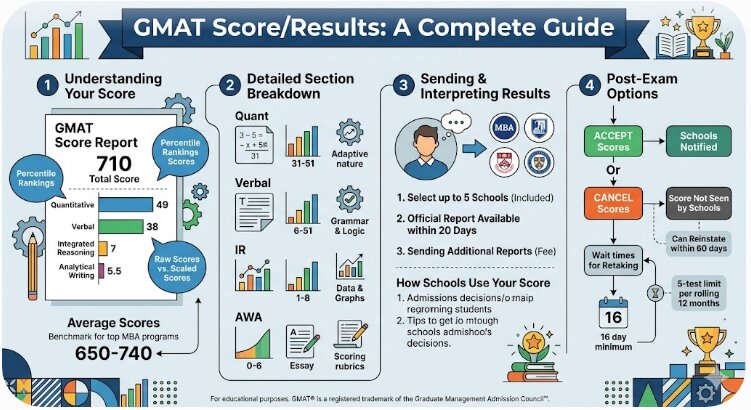
The GMAT is divided into four sections, each with its own scoring scale:
Analytical Writing Assessment (AWA)
- Score range: 0–6
- Scored in half-point increments
- Assesses your ability to analyze arguments and communicate ideas effectively
Integrated Reasoning (IR)
- Score range: 1–8
- Scored in one-point increments
- Measures your ability to evaluate data from multiple sources
Quantitative Reasoning
- Score range: 6–51
- Scored in one-point increments
- Tests mathematical skills and problem-solving ability
Verbal Reasoning
- Score range: 6–51
- Scored in one-point increments
- Measures reading comprehension, critical reasoning, and grammar
Total GMAT Score
- Ranges from 200 to 800
- Calculated based on your performance in Quantitative and Verbal sections only
- Most test-takers score between 400 and 700
3. How Your GMAT Results Are Reported
- Unofficial Score Report: Immediately after completing the test, you’ll receive an unofficial score for the Verbal, Quantitative, Integrated Reasoning, and Total Score sections.
- Official Score Report: Available online within 7–20 days after your exam. This includes all four section scores plus percentile rankings.
- Score Validity: GMAT scores are valid for five years from your test date, allowing you to apply to programs at your convenience.
4. Score Percentiles and What They Mean
Each section and the total GMAT score are accompanied by a percentile ranking. This ranking shows the percentage of test-takers you outperformed in the past three years. For example, a total score of 700 typically places you in the 88th percentile, meaning you scored higher than 88% of all test-takers.
5. Sending Your GMAT Scores to Schools
- Free Reports: You can select up to five schools to send your GMAT scores for free right after the test.
- Additional Reports: You may send scores to more schools for a fee (about $35 per report).
- Score Cancellation: If you are unhappy with your score, you can cancel it at the test center or within 72 hours online. Cancelled scores are not sent to schools.
- Score Reinstatement: If you change your mind after cancelling, you can reinstate your score within four years and 11 months for a fee.
6. Interpreting Your Score for Business School Admissions
- Average Scores: Most top MBA programs have average GMAT scores between 690 and 730. However, a competitive application can sometimes compensate for a slightly lower score.
- Sectional Balance: Many schools value a balanced score across Verbal and Quantitative sections.
- Retaking the GMAT: You can retake the test up to five times in a rolling 12-month period (and eight times in a lifetime) to improve your score.
7. Frequently Asked Questions
Q: What is a good GMAT score?
A: A “good” GMAT score depends on your target schools. For top programs, aim for 700+. Most business schools publish the average score of their incoming class.
Q: Can I choose which scores to send?
A: Yes. The Score Report lets you decide which scores from the last five years to send to each school.
Q: How soon can I retake the GMAT?
A: You must wait at least 16 days before retaking the test.
Q: Do schools see all my GMAT attempts?
A: Only the scores you choose to send will be visible to the schools.
8. Tips for Improving Your GMAT Score
- Begin preparing at least three months before your test date.
- Take practice tests to identify your strengths and weaknesses.
- Focus on time management and familiarize yourself with the test format.
- Use official GMAT prep materials for the most accurate practice.
9. Conclusion
Your GMAT score is a key part of your business school application. By understanding how scores are calculated, reported, and used by admissions committees, you can plan your test preparation and application strategy more effectively. Remember, the GMAT is just one part of your application—work to present a well-rounded profile for your best chance of success.
Related Posts

GMAT Sentence Correction removed...
23rd June, 2026
Is geometry on the GMAT Focus Edition...
23rd June, 2026
GMAT Focus score scale 205 to 805...
23rd June, 2026
GMAT Focus Edition vs Classic changes...
23rd June, 2026
How to Send Your GMAT Scores to Business Schools...
2nd June, 2026
Categories
Blog Posts






Breaking News
We usually sends BREAKING News to students of National Open University, NOUN. Not to miss any of our latest updates, enter your email here